A few years ago, a friend sent me a few links to articles about Olympics history and its revival in modern times. The first modern Olympics were held in Athens in 1896 with only 176 competitors from 12 countries. One of the Americans was a track-and-field competitor from Boston named Bill Hoyt. You can learn more about that here: http://durham.patch.com/articles/connecticuts-first-summer-olympics-champions-bill-hoyt-and-margaret-abbott-5ef986cd

Epaphras Hoyt, uncle of the prominent 19th-century American geologist Edward Hitchcock. c Pocumtuck Valley Memorial Association and Memorial Hall Museum, Deerfield, Massachusetts.
Hoyt is a family name with deep roots in the Connecticut River Valley. The 19th-century geologist Edward Hitchcock was a Hoyt on his mother’s side. He was particularly close with his Uncle Epaphras Hoyt, who encouraged his nephew’s scientific interests in natural history and astronomy. Young Edward and Uncle Epaphras published a paper on astronomy together, and the uncle supported his nephew’s desire to go to college. Originally, Edward’s heart was set on Harvard, but a bout of serious illness made him reconsider his place in the universe, and he rejected the idea of Harvard, which had become Unitarian, and returned to his father’s conservative orthodox Congregationalism. He became a minister and several years later went to Yale so he could take an academic position at then new Amherst College.
I wondered if Olympics gold medalist Bill Hoyt could have been a descendant of Epaphras or any other closely related family members. Checking through a Hoyt genealogy, I couldn’t connect Bill to any of the Deerfield Hoyts, but I did find that a Charles Arthur Hoyt was working as a chemist and mining engineer in Georgetown, Colorado, in 1870. Whoa, that’s interesting, I thought, because George Everett Marsh, son of dinosaur track discoverer Dexter Marsh, was working as a surveyor and mining engineer in Georgetown at that same time. A little more poking around showed that Charles’s father was Arthur Wellesley Hoyt, son of Epaphras. Thus Charles was a first cousin to Edward Hitchcock, one generation removed.
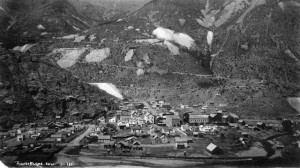
Historic view of the Silver Plume mine in Georgetown, CO, when the town had already grown and settled a bit. Courtesy of Clear Creek, a section of the town.
Georgetown was barely scraping out its place in the wild Rocky Mountains and Colorado wasn’t yet a state, but two descendants related to the discovery of dinosaur footprints in the Connecticut River Valley were living there in the 1870s. We cannot know if they were friends, but they certainly knew one another and might have worked together. Also, Georgetown is a mere 35 miles from Morrison, Colorado, where fossilized dinosaur skeletons were discovered in 1877, setting off the now famous “Bone Wars” between Othniel Charles Marsh (no relation to George and Dexter) and Edward Drinker Cope. Did wither of them ever go down to see the bones? Did George recognize their paleontological connection to the footprints his father discovered? Did he ever chew the fat with Arthur Lakes, discoverer of the Morrison Formation skeletons?
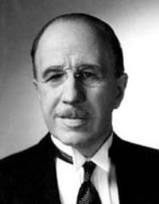
Arthur Hoyt, the personification of fussbudgetry.
Charles Hoyt married Josephine Briggs and they had two sons, Arthur, born in Georgetown in 1874, and Harry, in Minneapolis in 1885. If you have ever watched old Hollywood movies, you have probably seen Arthur Hoyt a zillion times. Starting in silents and continuing into talkies, he eventually carved out a niche for himself playing the milquetoast, the hen-pecked husband, the fusspot banker, the Nervous Nellie. I recognized him the moment I saw his photo. He made over 275 movies and worked regularly with a lot of big names: directors Preston Sturges and Frank Capra, actors Henry Fonda, Spencer Tracy, William Demarest, Clark Gable, Barbara Stanwyck, Eddie Bracken, Charles Coburn, Joel McCrae, Claudette Colbert, Mary Astor, Rudy Vallee, even early Gloria Swanson, Fanny Brice, Rudolph Valentino — the list goes on and on. That is the company kept by the great-grandson of General Epaphras Hoyt, military historian, major-general in the Massachusetts militia, staunch citizen and proud descendant of the Puritan founders of Deerfield, Massachusetts. It’s hard to know whether Epaphras would have been pleased or appalled by his great-grandson’s life.

Arthur Hoyt plays Professor Summerlee in his brother’s silent movie, The Lost World, based on the story by Arthur Conan Doyle.
Harry, Arthur’s younger brother, was in the movies, too, mostly as a director. Arthur even appeared in at least one of Harry’s productions, which happens to have been the first filmed version of Arthur Conan Doyle’s dinosaur story, The Lost World. Wow. The film is dated 1925, thus only 13 years after Doyle’s story was published. It starred Wallace Beery as Professor Challenger and Bessie Love as Paula White, the love interest of Edward Malone, played by Lloyd Hughes. Arthur played Professor Summerlee, the scientist character. Here it is: A family’s fascination with paleontology tumbles down the generations, first as science, then as art.
This version of The Lost World is available on DVD. The story takes place on a vast mesa deep in the jungle of South America, about as exotic a setting as an Irish Scottish Englishman such as Doyle could imagine, so distant in space, time, and familiarity that it could somehow seem feasible that dinosaurs would still live there, beyond the reach of the modern world — until the modern world reached them. Doyle chose the site based on the reports of a friend, Percy Fawcett, who went on expeditions to Bolivia. The Wikipedia entry notes that the region had “monstrous tracks of unknown origin,” a pretty apt description of the reactions of Dexter Marsh, James Deane, Edward Hitchcock, and all the townspeople who first gaped at the “bird tracks” in the sandstone of western Massachusetts.
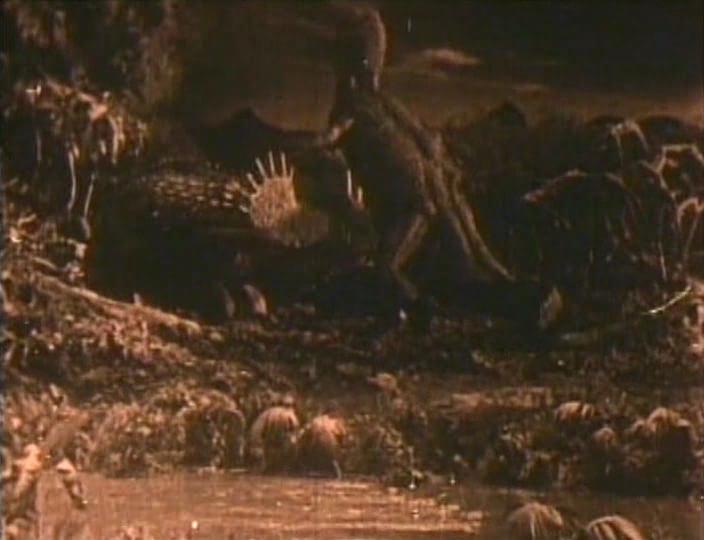
Still from O’Brien’s dinosaur animation in The Lost World. (Public domain image from Wikipedia.)
Directorial credit is generally given to Harry Hoyt and Willis O’Brien, sometimes to only one or the other, without explanation. It appears that Hoyt was the director and O’Brien responsible for special effects, which he further developed a few years later in King Kong and the long career that followed. It is well worth a few minutes to take a look at the film clips on O’Brien’s Wikipedia page. In 1916, he was already making animated dinosaurs, only two years after the first animated dinosaur movie, Windsor McCay’s Gertie the Dinosaur (1914). While Gertie is clever, The Dinosaur and the Missing Link: A Prehistoric Tragedy is funnier, the special effects are a riot, and the quail looks pretty much like a therapod. The Ghost of Slumber Mountain (1918) is also there, and you’ll find a clip from The Lost World as well. I wonder if Slumber Mountain is the first filmed depiction of a battle between a ceratopsian and a tyrannosaur. It is apparently the first to use live and animated figures together. The animation surprisingly smooth, especially in comparison to the jerky motions of humans in films of the era. The creatures were made of armatures coated in rubber skins, with air bladders inside that gave the illusion of breathing. The effect is wonderful.
What does this mean in the grand scheme of things? Probably not a lot, yet the story sparks the imagination. Maybe Charles Arthur Hoyt and George Everett Marsh were friends, despite the class differences of their origins. Or maybe they were uncomfortable at finding one another in the same little town so far from home, where each hoped to stake out a new life free of reminders of the past. Maybe one was the other’s boss at work. And yet, perhaps Arthur and Harry Hoyt heard stories from their father about cousin Edward, who wrote the first significant paper on the subject of dinosaur footprints (and, incidentally, became a college president). Perhaps, when they heard about the bones in the Morrison Formation — which they certainly would have, as it was very big news — they thought of Edward’s description of humongous birds and wondered how they related to the skeletons. Perhaps they knew that George’s father was the famous Dexter Marsh from Greenfield. Certainly, they all were among the first generations of (mostly) boys who grew up dreaming of strange worlds full of gigantic reptilian beasts that thrilled their young imaginations.
From the time of the first scientific discovery of the footprints in 1835 to the first movie animations in 1914 was nearly 80 years. The footprints in the sandstone of western Massachusetts, although shockingly large to mid-19th-century observers, came from late Triassic and early Jurassic dinosaurs that had not reached the mind-boggling sizes found in the late Jurassic skeletons of the Morrison Formation. The footprints evoked images of very big birds, a frightening thought but probably not as terrifying as the huge reptiles with sharp teeth that Hollywood imagined as how dinosaurs looked and moved. That the story can be traced through one family (or two, with the Marshes) is remarkable.
 Jurassic Roadshow